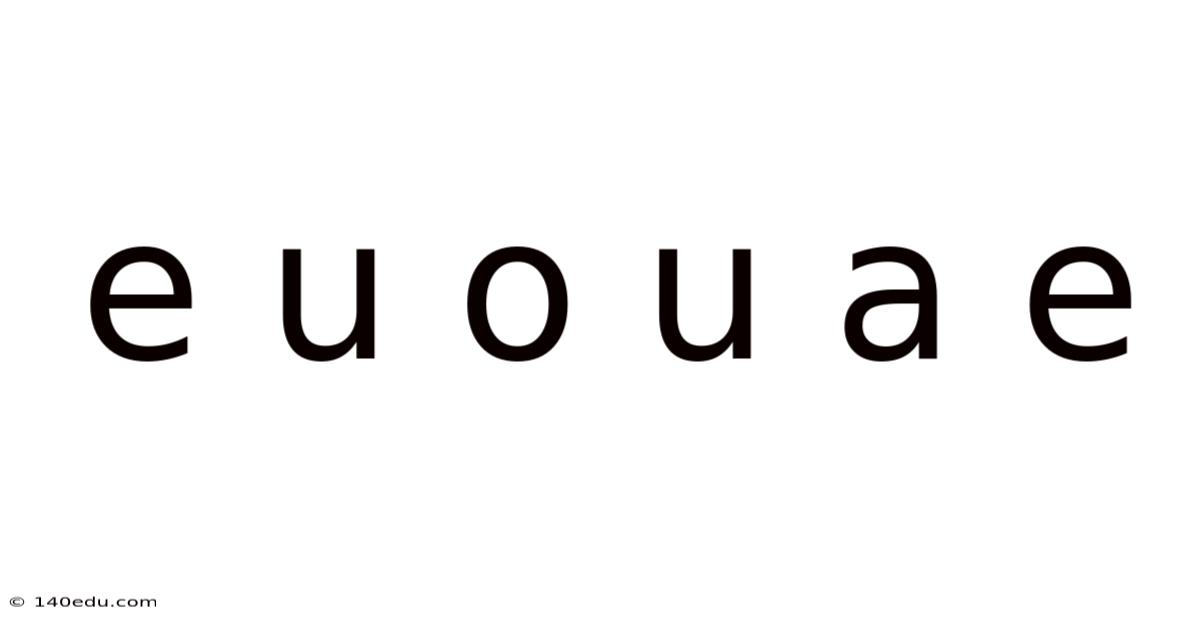
e u o u a e
Introduction
Euouae is a fascinating linguistic oddity that consists solely of the letters e, u, o, u, a, e—a sequence of six vowels that forms the longest word in English composed entirely of vowel characters. While it may appear to be a mere string of vocalic symbols, this term carries a rich history spanning medieval music, Gregorian chant, and modern linguistic curiosity. Understanding euouae offers insight into how language evolves, how music notation developed, and why certain vowel clusters capture the imagination of scholars and enthusiasts alike. This article explores the definition, origins, phonetic properties, historical context, and cultural relevance of euouae, providing a comprehensive look at why this vowel‑only word remains a standout in the English lexicon Most people skip this — try not to..
What Is Euouae?
Euouae entered the English language as a loanword from Latin, where it was used in medieval music theory to denote a specific melodic passage. The term is most famously noted in the Magna et Mira manuscript, a collection of Gregorian chant notations from the 12th century. In this context, euouae functions as a cadence—a concluding phrase that signals the end of a musical section. Its composition of only vowels makes it unique among English words, a fact that has sparked interest among linguists, musicians, and wordplay enthusiasts. The word is pronounced roughly as yoo‑oo‑way (IPA: /juːˈuːweɪ/), reflecting the natural flow of the vowel sounds without any consonants interrupting the melodic line.
Phonetic and Linguistic Analysis
From a phonetic standpoint, euouae showcases the flexibility of vowel sounds in English. The sequence includes:
- e – as in see (/iː/)
- u – as in food (/uː/)
- o – as in go (/oʊ/)
- a – as in father (/ɑː/)
These vowels span a broad acoustic range, covering front, central, and back positions on the vowel chart. The repetition of u and e creates a rhythmic pattern that mirrors the cadence’s musical function. Linguistically, euouae demonstrates that a word can be meaningful within a specialized domain (musical notation) even without consonants. It also illustrates how loanwords can retain their original orthographic and phonological characteristics while becoming part of a new language’s vocabulary.
Historical Context: Medieval Music and Gregorian Chant
During the Middle Ages, the Catholic Church standardized a body of plainchant known as Gregorian chant, named after Pope Gregory I. These chants were used in liturgical services and required precise melodic guidance. Medieval scribes developed musical formulas—short, repeatable patterns—to help singers memorize and reproduce complex melodies. Euouae emerged as one such formula, appearing in several medieval manuscript sources, including the St. Gallen and Bern codices. Its vowel‑only nature made it easy to sing without breaking the flow of the chant, serving as a mnemonic device for both singers and composers.
The word’s significance extends beyond its practical use in chant notation. It reflects the medieval fascination with musical modes and the belief that pure vowel sounds could convey spiritual purity. In the context of Gregorian chant, vowels were considered the most appropriate vehicles for sacred text, and euouae embodied this ideal by stripping away consonants and focusing solely on the resonant qualities of the human voice.
Cultural Impact and Modern Relevance
Although euouae is rarely encountered outside specialized musicological studies, its influence persists in contemporary culture. Puzzle creators and linguists often cite it as an example of a vowel‑only word, using it in word games such as Scrabble and Crossword puzzles. Its unique composition also makes it a popular subject in linguistic trivia and educational materials about phonetics But it adds up..
In literature, euouae appears as a symbol of musical elegance and linguistic playfulness. Which means for instance, the poet James Joyce references vowel‑only constructions in his works, echoing the medieval tradition of exploring the limits of language. Additionally, modern composers occasionally incorporate euouae into experimental pieces, using its vowel sequence as a melodic motif that highlights the human voice’s capacity for pure tonal expression.
How to Pronounce Euouae: A Step‑by‑Step Guide
- Start with the “yoo” sound – This corresponds to the letter e in see.
- Transition to the “oo” sound – Represented by u in food.
- Slide to the “way” sound – This combines o (as in go) and a (as in father), ending with a soft e (as in the).
- Maintain a smooth, connected flow – Because the word originated as a musical cadence, it should be spoken without pauses, allowing the vowel sequence to glide naturally.
Practice tip: Recite the word slowly, emphasizing each vowel, then increase your speed until the pronunciation feels fluid and musical.
Frequently Asked Questions (FAQ)
1. Is euouae the longest vowel‑only word in English?
Yes. While there are other vowel‑only strings like ae and oe, euouae holds the record for length, comprising six vowel letters without any consonants And it works..
2. Does euouae have any meaning beyond its musical use?
In contemporary English, *
