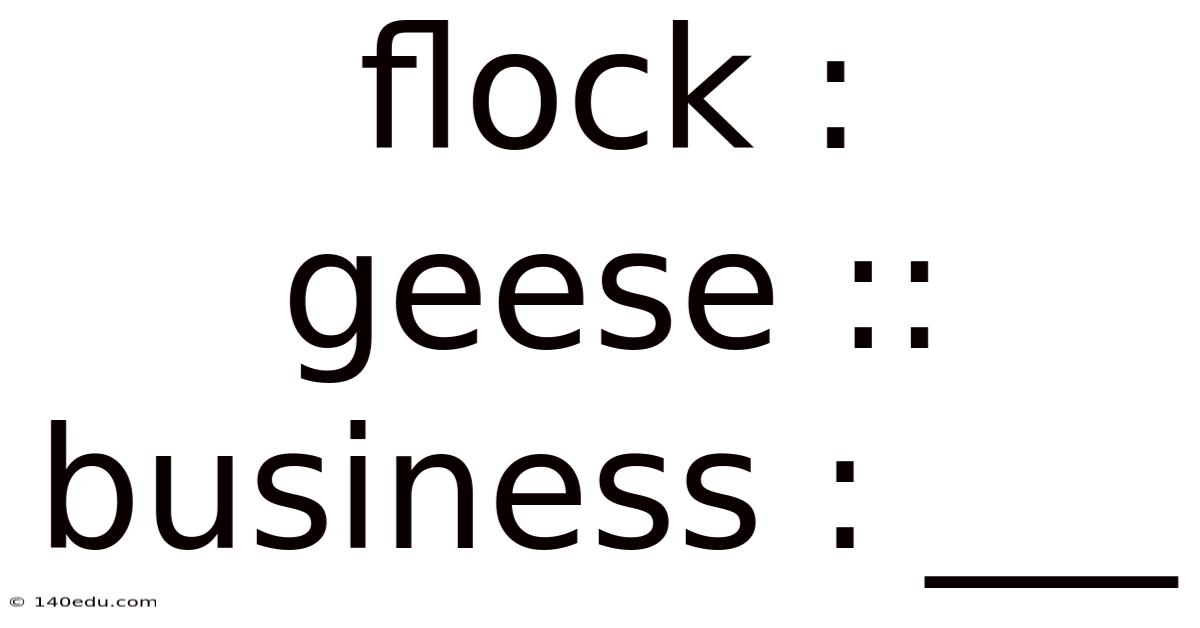
Understanding the Analogy “Flock : Geese :: Business : ___” and What It Reveals About Modern Enterprises
The analogy “flock : geese :: business : ___” is a powerful mental shortcut that compares the natural organization of a group of geese to the structure of a business. By exploring this parallel, we can uncover essential principles of teamwork, leadership, and adaptability that drive successful companies. The blank in this analogy is most commonly filled with “company,” but the deeper insight lies in recognizing how a business, like a flock of geese, functions as a cohesive unit where each member plays a vital role. This article unpacks the analogy, examines the characteristics shared by flocks and businesses, and offers practical lessons entrepreneurs can apply to build resilient, high‑performing organizations.
Easier said than done, but still worth knowing.
What the Analogy Means
At its core, an analogy draws a relationship between two pairs of items. ** The second pair mirrors this by showing a **group (business) composed of a specific type of organization (company).In practice, in “flock : geese :: business : ___,” the first pair shows a **group (flock) composed of a specific type of animal (geese). ** The analogy suggests that just as a flock is defined by its members—geese that migrate, communicate, and protect one another—a business is defined by its members—people who collaborate, innovate, and sustain the enterprise.
The official docs gloss over this. That's a mistake Small thing, real impact..
Key Elements of the Comparison
- Collective Identity: A flock’s identity is inseparable from its geese; a business’s identity is inseparable from its company’s culture and workforce.
- Shared Purpose: Geese fly together to conserve energy and reach destinations efficiently. Companies operate with a unified vision to achieve market goals.
- Interdependence: Each goose contributes to the group’s success; each employee, supplier, and stakeholder contributes to the business’s health.
The Natural World of a Flock
To appreciate the analogy, we need to look at how geese behave in nature And that's really what it comes down to. And it works..
1. Leadership Rotation
Geese fly in a V‑formation, where the lead bird experiences the most resistance. After about 30 minutes, the lead switches to another goose, allowing the group to share the workload. This rotational leadership teaches businesses that no single person should bear all the pressure; leadership responsibilities should be distributed to maintain stamina and morale.
2. Communication Through Calls
Geese emit specific honks to signal danger, celebrate success, or coordinate turns. Their vocal communication ensures the flock stays aligned. In a business, clear, timely communication—through meetings, newsletters, or digital platforms—keeps teams synchronized and responsive That alone is useful..
3. Shared Energy and Efficiency
The V‑formation creates an aerodynamic advantage, reducing drag for each bird by up to 70 %. This phenomenon, known as drafting, illustrates how collaboration can amplify individual effort. Companies that build teamwork and shared resources can achieve greater productivity with fewer resources.
4. Mutual Support During Illness
When a goose falls ill or injured, two others will stay behind to help it, even if it means slowing the entire flock. This protective behavior underscores the importance of a supportive corporate culture where employees feel valued and assisted during challenges.
Defining a Business in the Same Light
A business is an organized entity engaged in commercial, industrial, or professional activities. Its core components include:
- People: Employees, founders, and partners.
- Capital: Financial resources, investments, and assets.
- Processes: Operational workflows, marketing strategies, and customer service.
- Purpose: The mission and vision that guide decision‑making.
When we view a business as a company, we point out the structured organization that brings these components together. A company is not just a legal entity; it is a living system where people interact, processes evolve, and purpose drives growth.
Filling the Blank: “Company”
The most straightforward completion of the analogy is:
Flock : Geese :: Business : Company
This pairing highlights that a company is the organizational vessel that houses the people, processes, and purpose of a business, just as a flock is the vessel that houses the geese. On the flip side, the analogy goes beyond the label; it invites us to examine how a company can emulate the natural efficiencies of a flock Not complicated — just consistent. Took long enough..
Applying Flock Principles to Business
1. Adopt Rotational Leadership
- Implement shared leadership roles (e.g., project leads, department heads) to prevent burnout.
- Create mentorship pipelines where senior leaders rotate through coaching positions, fostering development across the organization.
2. Enhance Communication Channels
- Standardize regular updates (daily stand‑ups, weekly newsletters) to mirror geese’s honking.
- Use visual cues (dashboards, infographics) to signal priorities and celebrate milestones, similar to how geese use wing beats.
3. apply Collaborative Structures
- Form cross‑functional teams that work in “V‑formations,” each member supporting the other’s strengths.
- Encourage knowledge sharing through internal wikis, peer reviews, and collaborative software.
4. Cultivate a Culture of Mutual Support
- Offer employee assistance programs that provide resources during personal or professional hardships.
- Implement recognition programs that highlight teamwork, echoing the geese’s protective behavior.
Scientific Explanation: Why Flocks Work
Collective Intelligence
Research in collective animal behavior shows that flocks exhibit swarm intelligence—the emergent capability of groups to solve problems without centralized control. In businesses, collective intelligence manifests as innovative solutions that arise from diverse perspectives and decentralized decision‑making.
Energy Conservation and Resource Optimization
The aerodynamic benefits of the V‑formation are a classic example of resource optimization. Companies can apply similar principles by streamlining processes, eliminating redundancies, and sharing resources across departments to reduce waste and improve efficiency.
Adaptive Learning
Geese continuously adjust their flight paths based on weather, obstacles, and group dynamics. Businesses must adopt agile methodologies—iterative planning, continuous feedback, and rapid adaptation—to stay competitive in changing markets.
Frequently Asked Questions (FAQ
Frequently Asked Questions (FAQ)
Q1: How can we measure the impact of adopting flock‑inspired practices?
A: Start by establishing baseline metrics for key areas such as employee engagement, turnover, project cycle time, and resource utilization. After implementing rotational leadership, enhanced communication, or collaborative structures, track changes in these indicators over quarterly intervals. Improvements in engagement scores, reduced burnout reports, shorter delivery times, and lower operational waste are strong signals that the flock principles are taking root Took long enough..
Q2: What if our organization’s hierarchy is deeply entrenched—can we still apply shared leadership?
A: Yes. Shared leadership does not require dismantling hierarchy; it works by layering informal influence atop formal authority. Identify natural “flight leaders” within teams—individuals who consistently mentor peers, make easier problem‑solving, or champion cross‑functional initiatives. Give them temporary authority (e.g., as sprint scrum masters or project champions) while preserving their formal reporting lines. Over time, this practice cultivates a leadership pipeline that coexists with existing structures Small thing, real impact. Turns out it matters..
Q3: Are there risks to over‑emphasizing constant communication, like the geese’s honking?
A: Excessive or poorly timed communication can create noise fatigue. To avoid this, adopt a “signal‑to‑noise” approach: reserve synchronous updates (stand‑ups, huddles) for moments when real‑time coordination is critical, and use asynchronous channels (newsletters, dashboards) for routine information. Encourage teams to define what constitutes a “honking moment”—a genuine need for immediate attention—so communication remains purposeful rather than habitual.
Q4: How do we make sure knowledge sharing does not become a bureaucratic burden?
A: Treat knowledge assets like the geese’s wing beats—light, frequent, and purposeful. Use lightweight platforms (internal wikis with version‑light editing, short video demos, or community‑of‑practice Slack channels) that reward quick contributions. Implement a “knowledge‑gardening” role (rotating among team members) responsible for curating, tagging, and archiving content, preventing accumulation of outdated or redundant material Easy to understand, harder to ignore..
Q5: Can the flock analogy help with remote or hybrid work environments?
A: Absolutely. The V‑formation’s core benefit—reducing drag through coordinated positioning—translates to virtual teams aligning their workflows to minimize context‑switching and duplication. Use virtual “formation boards” (shared Kanban or Miro boards) where each member’s task is visible and linked to successors, mirroring how each goose benefits from the uplift of the bird ahead. Regular virtual check‑ins act as honks, preserving cohesion despite physical distance Took long enough..
Conclusion
By looking to the disciplined yet fluid dynamics of a goose flock, businesses uncover a timeless blueprint for resilience, efficiency, and collective intelligence. Here's the thing — rotating leadership prevents burnout, transparent communication keeps the group aligned, collaborative structures amplify individual strengths, and a culture of mutual support safeguards well‑being during turbulence. When these principles are embedded—measured, adapted, and sustained—organizations not only conserve energy but also generate the lift needed to soar above market challenges. In essence, treating a company as a living flock transforms strategy from a static plan into an evolving, self‑optimizing formation that propels every member forward together.
