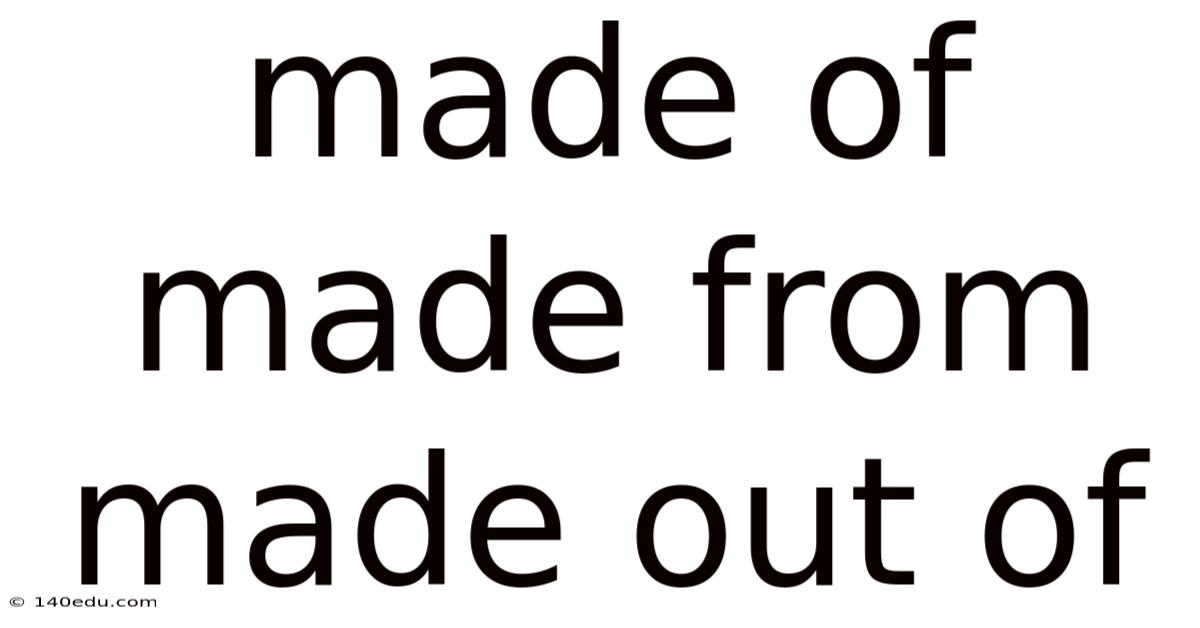
Understanding the subtle differences between made of, made from, and made out of is a milestone for anyone aiming to master English fluency. In real terms, while these phrases all describe the materials or ingredients used to create something, they are not interchangeable. The choice depends entirely on whether the original material has undergone a significant chemical or physical transformation, or if it remains visible and recognizable in the final product. This guide breaks down the grammar rules, provides clear examples, and explores the nuanced "gray areas" so you can use these phrases with native-like precision Surprisingly effective..
The Core Distinction: Transformation vs. Visibility
The fundamental rule governing these three phrases revolves around the state of the material in the finished object. Ask yourself: *Can I still see the original material? Has it changed its essential nature?
1. Made Of: The Material Remains Visible
Use made of when the material used to create the object has not changed its fundamental nature. You can still see, touch, or identify the original substance in the final product. The material retains its original properties And that's really what it comes down to..
- Structure: Subject + be + made of + material (uncountable/plural noun).
- Key Concept: Reversibility (theoretically). You could take the object apart and get the material back in its original form.
Examples:
- This table is made of solid oak. (You can see the wood grain; it is still wood).
- The bridge is made of steel and concrete. (The materials are visibly steel beams and concrete slabs).
- Her ring is made of gold. (The metal is still gold; it hasn't turned into something else).
- The shirt is made of cotton. (The fibers are still identifiable as cotton).
Grammar Tip: Because the material hasn't changed, we often use made of when describing the composition or constitution of an object Which is the point..
2. Made From: The Material Has Been Transformed
Use made from when the original material has undergone a significant chemical or industrial process. It has changed its form, nature, or appearance so drastically that you cannot "see" the original ingredient in the final result. You cannot reverse the process easily.
- Structure: Subject + be + made from + raw material/ingredient.
- Key Concept: Irreversibility. The raw material ceases to exist in its original state.
Examples:
- Paper is made from wood pulp. (You cannot see the wood in the paper; it has been pulped, bleached, and pressed).
- Wine is made from grapes. (The grapes have fermented; they are no longer grapes).
- Cheese is made from milk. (Milk has curdled and aged; it is chemically distinct).
- Plastic is made from petroleum. (The crude oil has been refined and polymerized).
- This juice is made from concentrate. (Water was removed, then added back; the original state was altered).
Scientific Context: In technical or scientific writing, made from is the standard for describing synthesis, manufacturing, and biological processes where the input differs chemically from the output.
3. Made Out Of: Repurposing and Improvisation
Made out of is the most colloquial of the three. It shares the "visibility" characteristic of made of (the material hasn't chemically changed), but it carries a specific connotation: repurposing, improvisation, or unusual construction.
It implies the object was built using a specific material, often suggesting that the material wasn't the standard or intended choice for that object, or that the speaker is focusing on the act of construction from components.
- Structure: Subject + be + made out of + material/components.
- Key Concept: Construction from parts or Unconventional usage.
Examples:
- The kids built a fort made out of cardboard boxes. (Cardboard boxes weren't "fort material" originally; they were repurposed).
- Her dress is made out of recycled plastic bottles. (Highlighting the eco-friendly repurposing).
- He made a temporary splint out of a ruler and a magazine. (Improvisation in an emergency).
- The sculpture is made out of scrap metal. (Artistic repurposing of waste).
Nuance Check: You can say "The table is made out of oak," and it is grammatically correct. On the flip side, it sounds slightly less formal than "made of oak." It draws attention to the substance as a building block rather than the inherent composition.
The "Gray Area": Made Out Of vs. Made Of
Learners often struggle here because both describe visible materials. The difference is register (formality) and focus.
| Feature | Made Of | Made Out Of |
|---|---|---|
| Formality | Standard, Neutral, Formal | Informal, Conversational |
| Focus | Composition / Constitution | Construction / Fabrication |
| Typical Use | Describing what something is. | |
| Example | "The walls are made of brick. | Describing how something was built or what it uses. " |
Rule of Thumb: If you are writing a technical specification, a product description, or a formal report, default to made of. If you are telling a story about a DIY project, an art piece, or an improvised solution, made out of feels more natural It's one of those things that adds up..
The Fourth Contender: "Made With" (Ingredients vs. Materials)
While your focus is on the "Big Three," you cannot master this topic without understanding made with. This phrase shifts the focus from the primary structural material to ingredients, components, or additives.
- Made of/from/out of = The main substance (The "Body").
- Made with = The contents or additions (The "Flavor/Feature").
Examples:
- This cake is made from flour, eggs, and sugar (Main ingredients transformed). It is made with real vanilla extract (Specific quality ingredient).
- The salad is made with fresh herbs. (The herbs are a component, not the whole salad).
- This software is made with Python. (The tool/language used, not the physical material).
Critical Distinction: You would never say "The table is made with wood" (unless wood is just one of many materials, like "made with wood and metal accents"). You would say "The table is made of wood."
Deep Dive: Scientific and Industrial Contexts
In engineering, chemistry, and manufacturing, the precision of these terms becomes legally and technically vital.
Material Science: "Made Of" Defines Properties
When a datasheet says a gear is made of hardened steel, it defines the bulk material properties—tensile strength, density, thermal conductivity. The steel is the gear Small thing, real impact..
Chemical Engineering: "Made From" Defines Process Flow
A process flow diagram shows crude oil entering a refinery and gasoline leaving. The gasoline is made from crude oil. The feedstock (crude oil) and the product (gasoline) have different chemical formulas (C~n~H~2n+2~ vs complex hydrocarbon chains). The distinction highlights the value-add of the processing plant.
Sustainability Reporting: "Made Out Of" Defines Circularity
Modern sustainability reports love made out of. "Our packaging is made out of 100% post-consumer waste." This
